|
|||||||||
 |
 |
 |
 |
 |
 |
 |
|||
-------------------------------------------- George Schafer P I s : -------------------------------------------- --------------------------------------------
-------------------------------------------- Right and below: our prototype and pictures from assessments.
|
 |
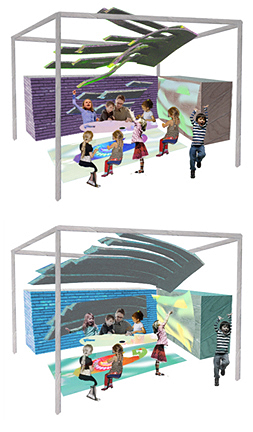
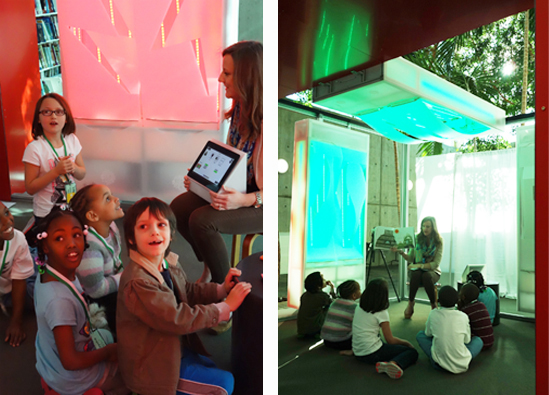
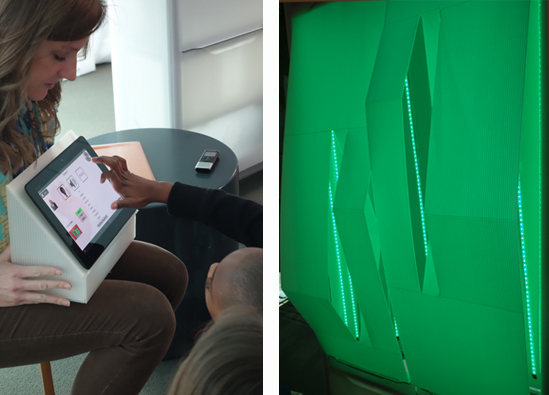
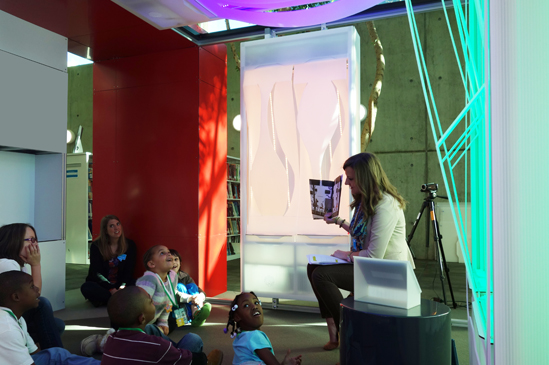
The LIT ROOM | An evocative, literacy support tool at room-scale. A video overview of the LIT ROOM by the student lead. o v e r v i e w : The LIT ROOM features a novel suite of user-friendly, networked, “architectural-robotic” artifacts embedded in the everyday physical space of the public library. This cyber-physical environment is transformed by words read by its young visitors so that the everyday space of the public library “merges” with the imaginary space of the book: The book is a room. And should the LIT ROOM’s intelligent reconfigurations not match the imagined spaces of young readers, the young readers “fine-tune” the room through tangible interfaces. Our efficacy studies suggest that literacy can be cultivated in a space that is at once physical and digital and evocative of the book being read. Our test bed was a ground zero for literacy: Richland Library of Columbia, South Carolina – the largest public library in a state that ranks among the lowest in the “State Technology and Science Index,” and among the highest in numbers of people who are both illiterate and living below the poverty line. Evaluations of the LIT ROOM design engaged children from local Title 1 schools who routinely visit the library for after-school reading programs. The LIT ROOM served various programs at the library for over a year. The broader impacts included a child-centered participatory design process in a real-world public space; a LIT KIT and website that extend the reach of the research, developed in a cross-listed course taught by the researchers; and the empowerment of children by way of playful interactions with robotic elements. As we come to live, play and work with robots, our team fundamentally strives to cultivate in children the capacity to shape a world that is physical, technical, increasingly digital and inherently social. Words become worlds.
p u b l i c a t i o n s : Schafer. G, Green, K. E., Walker, I. D. and Lewis, E. A Networked Suite of Mixed-Technology Robotic Artifacts for Advancing Literacy in Children. Proceedings of IDC 2012: the International Conference on Interaction Design and Children, June 12-15, Bremen, Germany, Germany, pp. 168-171. Publications on our The LIT KIT - the "portable LIT ROOM": p r e s s : Not too long ago, my family got to visit Richland Library in Columbia, SC. It was a work trip, but since it was Spring Break, my kids got to come along... While there, we had a chance to visit something called the LIT Room. My kids are still talking about it. The [LIT ROOM]...grew out of a partnership between the library and Clemson University as part of an effort to create an experimental learning space for youngsters that was equal parts high-touch and high-tech. The two organizations wanted to explore how children's comprehension of picture books is influenced, compared to a traditional story time space, in a multisensory environment. Earlier this year, [a] study was performed with a group of second grade students at Caughman Road Elementary in Richland 1, where students were read the same stories in traditional reading rooms and the LIT room. Students in both groups were asked to recall the stories they heard to determine whether there was a significant difference in memory. What was clear during Monday’s outing was that the youngsters were strongly engaged as library staff shared stories from books, mixed with effects from the LIT ROOM. “It’s one of the things that the kids remember most,” said Tony Tallent, the library’s director of literacy and learnin Tallent. “It comes alive.” r e s o u r c e s :
|
|
||||||
 |
|||||||||
 |
|
|
|
|
|
|
|
|
|